Women Who Changed the World with Their Inventions
Across centuries, women have engineered breakthroughs that reshaped how we live, move, communicate, and heal. Many fought for credit or saw recognition arrive decades late; yet their ideas endured. This feature highlights pivotal inventions (and hard truths) behind their stories.
Breaking Barriers in Technology
Hedy Lamarr: Frequency Hopping That Prefigured Modern Wireless (1942)
Actor-inventor Hedy Lamarr co-patented a “secret communication system” with composer George Antheil in 1942 that hopped among radio frequencies to resist jamming. The Navy didn’t deploy it in WWII; later spread-spectrum descendants undergird parts of today’s wireless ecosystem. Credit the patent and the principle, not the meme that she “invented Wi-Fi.”
Dr. Gladys West: The Math Behind GPS (1950s–1980s; honored 2018)
At the U.S. Naval Weapons Laboratory, Gladys West modeled Earth’s geoid with painstaking algorithms. Those models fed satellite navigation and, ultimately, the GPS in your pocket. Her role was formally recognized when she entered the U.S. Air Force Space and Missile Pioneers Hall of Fame in 2018.
Radia Perlman: Spanning Tree Protocol (1985)
Perlman designed the algorithm that prevents Ethernet loops so large local networks actually work. IEEE standardized a variant as 802.1D in 1990. Media nicknamed her the “Mother of the Internet”; more precisely, her work made switching reliable.
Barbara Liskov: Data Abstraction, CLU, and Behavioral Subtyping
Liskov’s research on data abstraction and robust software design (including what became known as the Liskov Substitution Principle) shaped modern programming. She received the 2008 ACM Turing Award for foundational work in languages and distributed systems.
Katherine Johnson: Human Computer for Mercury & Apollo
Johnson’s trajectory math was trusted for John Glenn’s 1962 orbital mission and contributed to Apollo navigation. At a moment when “computer” meant a person, her accuracy made spaceflight safer.
Grace Hopper: Early Compilers and the Road to COBOL (1951–1959)
Hopper led creation of the A-0 system, often cited as one of the first compilers, and then helped drive business-friendly languages like FLOW-MATIC and COBOL. She didn’t single-handedly “invent COBOL”; she made compilers practical and pushed the language into the mainstream.
Ellen Ochoa: Optics Inventor and First Hispanic Woman in Space
Before astronaut corps selection, Ochoa co-invented optical inspection and pattern-recognition systems (three patents). She then flew four shuttle missions and later directed NASA’s Johnson Space Center.
Dr. Shirley Ann Jackson: Physicist and Leader (Not the Inventor of Caller ID)
Jackson made significant contributions in theoretical and solid-state physics, chaired the U.S. Nuclear Regulatory Commission, and led RPI. Internet claims that she “invented” caller ID, call waiting, touch-tone phones, fiber optics, or the portable fax are false; her legacy is research, policy, and leadership; not those device patents.
Improving Daily Life
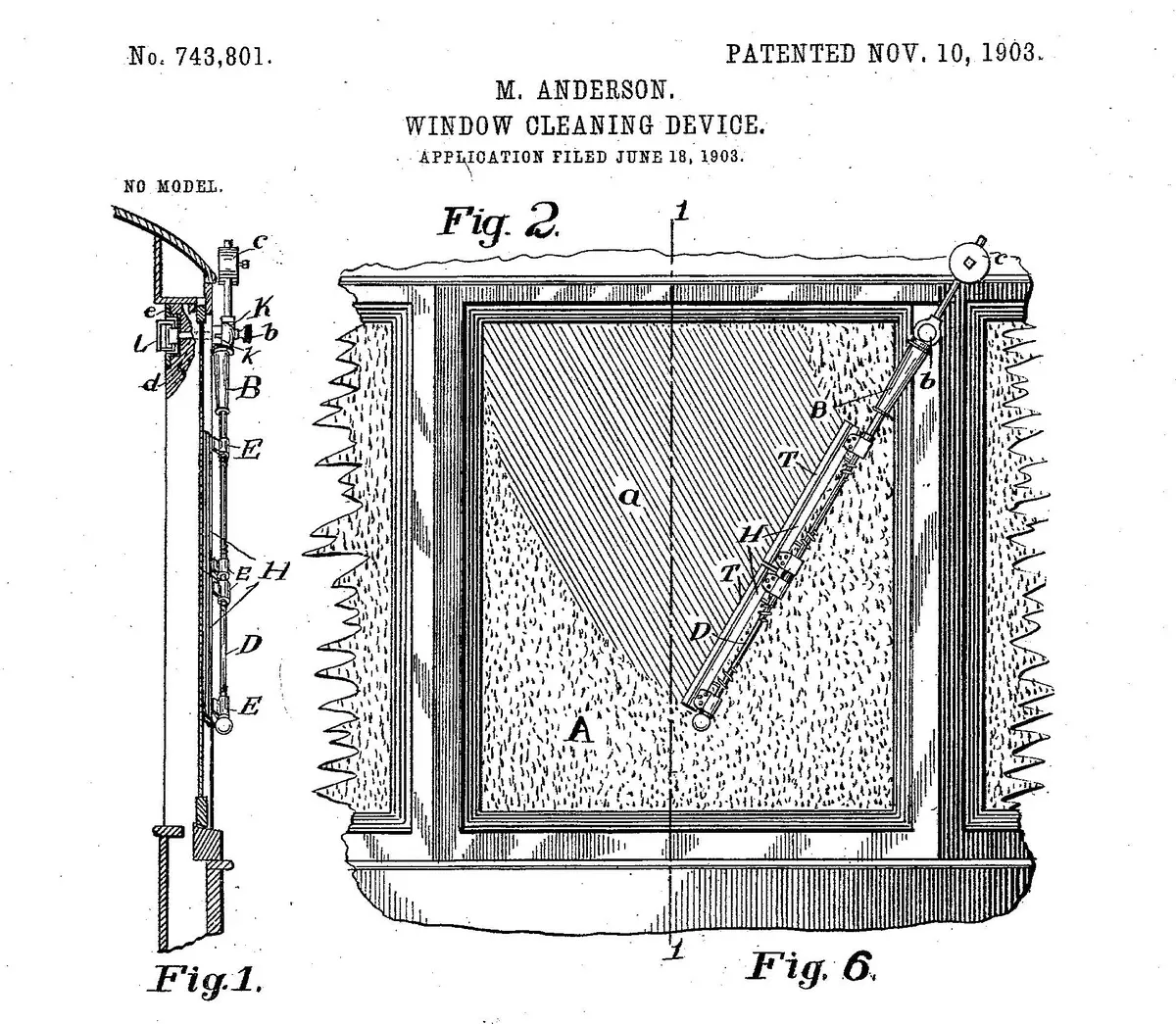
Mary Anderson: Windshield Wipers (U.S. Patent 743,801; 1903)
Anderson watched streetcar motormen squint through storms and built a hand-lever wiper you could operate from inside. Automakers scoffed; two decades later, wipers were standard kit.
Marie Van Brittan Brown: Home Security (U.S. Patent 3,482,037; filed 1966, granted 1969)
Brown’s design combined a door-mounted camera scanning multiple peepholes, a monitor, two-way audio, and remote door control. If your doorbell streams video to your phone today, you’re seeing her architecture’s DNA.
Melitta Bentz: Paper Coffee Filter (Utility model granted June 20, 1908)
Annoyed by bitter grounds, Bentz punched a brass pot and lined it with school blotting paper, then secured protection at Berlin’s Imperial Patent Office. Drip coffee was never the same, and a global brand was born.
Josephine Cochrane: The First Successful Dishwasher (U.S. Patent 355,139; 1886)
Cochrane’s rack-and-spray design cleaned with water pressure, not brushes. Hotels adopted it first; decades later, the concept matured into the home dishwashers we expect now.
Marion Donovan: The Waterproof Diaper Cover (U.S. Patent 2,556,800; 1951)
Donovan’s reusable “Boater” diaper cover solved leaks and rash in the late 1940s, then influenced the disposable-diaper industry that followed.
Bette Nesmith Graham: Correction Fluid (1950s)
A secretary tired of retyping used tempera paint to cover errors, refined the formula, and built Liquid Paper into a multimillion-dollar business. (Her chemistry evolved; the origin story wasn’t a one-and-done “accident.”)
Beulah Louise Henry: “Lady Edison” (49 U.S. Patents)
Henry prototyped everything from vacuum-seal ice-cream freezers to typewriter attachments; proof that prolific, market-savvy invention isn’t only a Silicon Valley sport.
Breaking Ground in Science & Medicine
Marie Curie: Two Nobels, Two Sciences
Curie shared the 1903 Nobel in Physics (with Pierre Curie and Henri Becquerel) and won the 1911 Nobel in Chemistry for isolating polonium and radium. She is still the only person to win Nobel Prizes in two different sciences.
Dr. Tu Youyou: Artemisinin for Malaria (2015 Nobel in Physiology or Medicine)
Tu mined classical medical texts and modernized extraction methods to isolate artemisinin from Artemisia annua, transforming global malaria treatment.
Dr. Patricia Bath: Laserphaco Cataract Surgery (U.S. Patent 4,744,360; 1988)
Bath’s Laserphaco probe uses laser energy to emulsify and remove cataracts through tiny incisions, restoring sight for patients worldwide.
Changing the Game: Entertainment & Food
Elizabeth Magie: The Landlord’s Game (U.S. Patent 748,626; 1904)
Magie built an anti-monopoly teaching game that later inspired Monopoly. The mass-market version buried her point, and her name, for decades.
Ruth Wakefield: The Toll House Chocolate-Chip Cookie (1930s)
Wakefield published the recipe in 1938 and later struck a deal with Nestlé to print it on bags of semi-sweet morsels. It wasn’t a fluke; it was product development done right.
Foundations & Firsts
Mary Dixon Kies: Often Cited as First U.S. Patent to a Woman (1809)
Kies received a patent for weaving straw with silk; an early milestone for women in U.S. intellectual property. (Records before 1836 are spotty; attributions vary, but her patent is widely recognized.)
Ada Lovelace: The First Published Algorithm for a Machine (1843)
Lovelace’s notes on Babbage’s Analytical Engine included a method to compute Bernoulli numbers and, more importantly, a vision of general-purpose computation beyond arithmetic.
Beyond the Inventions
Across these stories, a pattern repeats: initial dismissal, slow credit, then ubiquity. The windshield wiper that “nobody would want” is now a legal requirement. A frequency-hopping torpedo idea becomes wireless resilience. A math model of Earth becomes turn-by-turn directions. Good ideas outlast bad gatekeeping.