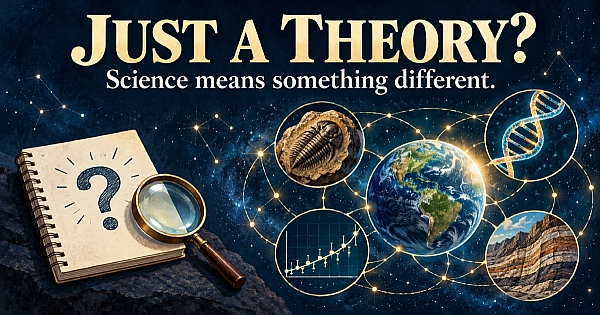
You’ve probably heard it: “But evolution is just a theory.” Maybe someone has said the same thing about climate change. It sounds like a reasonable objection. After all, you might have a theory that your missing socks are living behind the dryer.
The trouble is that “theory” means something different in science than it does in everyday conversation. Same word. Very different job. And that tiny language mix-up can make a mountain of evidence sound like a shrug.
A hypothesis is an idea you can put to the test
A scientific hypothesis is a proposed explanation that can be tested against evidence. Crucially, there must be some possible result that could show it is wrong. It’s more useful than a random guess because it gives you something to investigate. The National Academies’ definitions emphasize this testability.
Imagine your kitchen basil is looking miserable. Your hypothesis: it isn’t getting enough light.
That explanation leads to a prediction: if low light is the problem, otherwise similar basil plants given more suitable light should grow better than those kept in dim conditions. You could compare several plants, keep water and soil conditions similar, and record what happens.
If the better-lit plants thrive, that supports your hypothesis. If they don’t, you have a reason to reconsider. Maybe the roots are waterlogged. Maybe pests are involved. Your basil, inconveniently, refuses to provide written feedback.
Notice the distinction: the hypothesis explains; the prediction describes what you expect to observe if that explanation is right. One successful test is useful, but it doesn’t rule out every alternative.
A theory connects the bigger picture
An established scientific theory is a broad explanation supported by extensive evidence and repeated testing. It connects observations, helps explain how things work, and lets researchers make new predictions. The National Academies’ guide to science and evolution explains why this differs so sharply from the casual meaning of “theory.”
Think of a hypothesis as a particular explanation you’re checking, and a theory as a larger explanatory framework within which many questions can be investigated.
That framework isn’t a trophy scientists place on a shelf. It gets used. Researchers draw on theories to develop fresh hypotheses, design studies, and look for results that might reveal something missing.
So a theory isn’t an idea that escaped testing. Established theories have earned their standing through testing.
Science doesn’t have a promotion ladder
Here’s a surprisingly persistent myth: a guess becomes a hypothesis, which becomes a theory, which eventually becomes a law.
It’s a neat little staircase. It’s also misleading.
Hypotheses, theories, and laws serve different purposes. A law describes a regular relationship in nature, often mathematically. A theory provides an explanatory framework. Gathering more evidence doesn’t automatically turn one into the other. This distinction is discussed in the OpenStax explanation of scientific methods.
Your basil experiment won’t level up into the Universal Law of Sad Houseplants after its hundredth successful run. Instead, its results may support a specific explanation and contribute to broader scientific understanding.
Why evolution can be both a fact and a theory
“Evolution” can refer to the observed changes in inherited characteristics of populations across generations. Evolutionary theory explains the processes and patterns involved, including natural selection, mutation, genetic drift, and gene flow.
The evidence includes fossils, genetic relationships, and evolution observed in living populations. Those different lines of investigation reinforce one another. Calling evolution a theory describes its explanatory role; it does not mean scientists are waiting for evidence that populations change. The National Academies’ overview of evolution explores that evidence.
Scientists still investigate plenty of details: how a particular trait arose, how fast a population changed, or how different mechanisms interacted. Working out the details of a well-supported explanation is part of science, too.
And what about climate change?
Climate change isn’t simply one speculative idea labeled “a theory.” It involves observations of a changing climate, physical explanations, and models used to investigate what may happen next.
Rising global temperatures, warming oceans, shrinking ice, and rising sea levels are measured evidence. Greenhouse gases absorb and emit infrared radiation, affecting Earth’s energy balance. Evidence shows that human activities, especially the release of greenhouse gases, are the main driver of recent global warming. NASA’s evidence overview brings together several of these independent lines of evidence.
Questions remain about the exact size, timing, and local effects of future changes. Those uncertainties matter. They don’t erase what measurements and physics already establish.
Can a theory change? Absolutely.
Scientific explanations remain open to revision when compelling new evidence demands it. That openness is a strength: the goal is to describe nature accurately, not protect a favorite answer.
There’s a useful caution here, though. The word “theory” alone is not a guarantee of overwhelming support. It also appears in the names of proposed or developing frameworks. Always ask what evidence supports the particular idea, how it has been tested, and how well it explains the observations.
Next time you hear “it’s just a theory,” try a friendly question: “Do you mean a hunch, or a scientific explanation backed by evidence?”
That gets the conversation somewhere useful. And if you’re wondering about those missing socks, check behind the dryer. That hypothesis is delightfully testable.