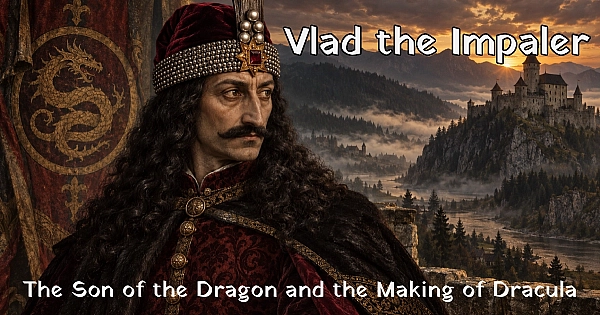
Before Dracula became a creature of the night, the name belonged to a man struggling to keep a throne. His country stood between great powers. His father had carried the dragon as a mark of honor. The son would leave a reputation so violent that, centuries later, history and horror would become almost impossible to separate.
The real Vlad III was a prince of Wallachia, in what is now southern Romania. He ruled three times: briefly in 1448, from 1456 to 1462, and once more in 1476. His life offers enough betrayal, danger, and cruelty without inventing a single vampire. Source: Treccani.
The father who became the Dragon
The story of the name begins with Vlad II, the future prince’s father. In the traditional historical account, he entered the Order of the Dragon in 1431 under Sigismund of Luxembourg, then king of Hungary and later Holy Roman Emperor. Founded in 1408, the order bound powerful nobles to the ruler and the defense of Christianity, including resistance to Ottoman expansion.
Its dragon emblem supplied Vlad II’s moniker, Dracul: the Dragon in this heraldic context. His son inherited Drăculea, commonly explained as “son of Dracul,” or “son of the Dragon.” Dracula was therefore a historical family designation long before it became a fictional vampire’s name.
There was already a darker association available. Romanian drac also meant devil, reflecting the old connection between dragons and demonic imagery. That overlap gave enemies a ready-made insult. The name did not suddenly change meaning because Vlad was cruel, and neither father nor son acquired it through vampire folklore. Source: Constantin Rezachevici, “From the Order of the Dragon to Dracula”.
A childhood held as security
Vlad was probably born around 1431. Sighișoara in Transylvania is the traditional birthplace, although the exact circumstances remain disputed. His father gained the Wallachian throne in 1436, bringing the family into a political world where neighboring rulers and rival noble families could decide how long a prince survived.
In the 1440s, Vlad and his younger brother Radu became hostages of the Ottoman sultan, guarantees of their father’s loyalty. They were royal children whose freedom had become part of a diplomatic bargain.
It is tempting to make those years the explanation for everything Vlad later did. The evidence cannot carry that weight. We know far more about his later campaigns than about his private thoughts as a captive.
In 1447, his father was killed after a Hungarian-backed intervention. His elder brother Mircea also died; accounts describe his blinding and burial alive. Vlad now had a claim to a throne and a family catastrophe behind him. Source: National Geographic.
A throne won, lost, and won again
The young prince’s first opportunity came in 1448, while the reigning Vladislav II was away campaigning with the Hungarian commander John Hunyadi. Vlad entered Wallachia with Ottoman support. His first reign lasted only weeks before Vladislav returned and forced him out.
The future opponent of Ottoman power had begun his career with Ottoman help. Survival on this frontier rarely followed a simple division between permanent friends and enemies.
Exile carried him through Ottoman territory, Moldavia, and Transylvania. By 1456 he had secured Hungarian backing and returned to Wallachia. Vladislav died during the struggle.
This time Vlad attacked the domestic foundations of opposition. He purged boyars, the powerful nobles whose loyalties could make or break a ruler, and redistributed property to supporters. Across the mountains, Saxon towns that sheltered rival claimants became enemies too. His campaigns against their communities included devastating violence. Source: Historical overview and cited scholarship.
The prince and the stakes
Vlad’s best-known name, Țepeș, means “the Impaler.” Impalement was a method of execution designed to prolong suffering and turn a human body into a public warning.
His brutality is not simply a modern invention. Yet the familiar catalogue of horrors needs careful handling. German-language stories circulated descriptions of atrocities; other traditions presented a severe ruler enforcing order. The same man could become a monster or a model of ruthless justice depending on who told the story.
Accounts of spectacular banquets, punishments, and enormous death tolls should not all be read as verified reports. Modern research has challenged inflated impalement totals in the surviving narratives. Recognizing exaggeration does not erase the victims. It makes the distinction between evidence and legend essential. Source: Live Science, reporting historians’ assessments and recent research.
The night he struck at a sultan
By the early 1460s, Vlad had broken with Ottoman demands for tribute. His attacks across the Danube brought war to Ottoman-held territory. In 1462, Mehmed II, the conqueror of Constantinople, invaded Wallachia.
Vlad could not comfortably meet the larger army in open battle. He used scorched-earth tactics to deny it supplies. On the night of June 16–17, he attacked the Ottoman camp in an attempt to reach the sultan. Mehmed survived.
The campaign also produced the infamous account of a field of impaled bodies near Târgoviște. A chronicler reported about 20,000 victims; that figure belongs to the historical account, rather than to an independently verified count.
Terror did not save Vlad’s throne. Radu emerged as an Ottoman-backed alternative and drew away support. Vlad sought help from Hungary’s Matthias Corvinus, who instead had him arrested in late 1462 amid accusations of treason. Years of confinement and restricted residence followed. Source: Aleksandra Bartosiewicz, “Dracula - non omnis moriar”.
A final return, and an uncertain grave
Vlad’s private life survives in fragments. His marriages and the identities of some family members remain debated. His son Mihnea would later become a Wallachian ruler. The famous tale of a wife leaping from a fortress belongs to legend and cannot be confidently narrated as a documented event.
Eventually Vlad became useful to Hungarian policy again. With Hungarian and Moldavian support, he recovered the throne in 1476. The restoration was brief. He died in renewed fighting late that year or early in 1477.
The exact circumstances of his death and the location of his remains are uncertain. Snagov is the celebrated traditional burial site; Comana has also been proposed. A confident ending would be satisfying, but the record does not provide one. Source: Live Science; Treccani.
How Dracula became a vampire
More than four centuries later, Bram Stoker encountered the name while researching his novel. In Whitby in 1890, he consulted William Wilkinson’s account of Wallachia and Moldavia. Stoker’s notes record Wilkinson’s explanation that Dracula meant devil.
Those working papers establish the borrowing of the name and limited historical material. They do not establish that Stoker built his vampire from a detailed study of Vlad’s life or his impalements. The familiar claim that Vlad was the complete blueprint for Count Dracula goes beyond the surviving evidence. Source: MIT’s guide to Christopher Frayling’s examination of Stoker’s papers.
Published in 1897, Dracula joined that ominous name to a fictional aristocrat and a much wider tradition of supernatural horror. Later adaptations made the connection to Vlad increasingly explicit. Stoker’s research notes, preserved at the Rosenbach, let us follow the novel’s development rather than rely entirely on the legends surrounding its author. Source: The Rosenbach Museum & Library.
The path from prince to vampire was therefore a succession of transformations: a father’s dragon emblem, a son’s inherited name, stories of a feared ruler, and a novelist’s choice. Vlad died. Dracula, carried from history into fiction, kept finding new lives.