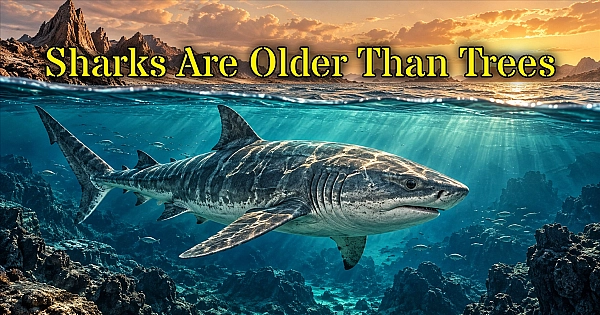
Picture a coastline with no trees. No palms leaning over the water. No forest beyond the beach. Nothing with a trunk and a leafy canopy to cast a patch of shade.
Now look beneath the waves. The story of sharks has already begun.
It sounds like someone has mixed up the order of things. Trees feel like part of Earth’s original scenery, while sharks seem to belong to a world that already had everything else in place. But the fossil record tells a different story: the shark family’s roots reach back further than the first known forests.
Before the First Forest
Our story begins roughly 450 million years ago, during a chapter of Earth’s history called the Ordovician Period. The earliest fossil evidence attributed to sharks or their ancestors comes from this time. It is surprisingly small: a few ancient scales.
That distinction matters. We are not talking about great white sharks cruising around exactly as they do today. We are tracing the beginnings of a much older family story, and those tiny remains cannot tell us precisely what the earliest animals looked like.
By about 410 million years ago, the evidence includes shark-like teeth from a fish called Doliodus problematicus. Its name is a mouthful, but its place in the story is simple: long before familiar forests spread across the land, ancient relatives of sharks were already developing their own ways of living underwater. The Natural History Museum traces this early history through the fossils.
When Trees Finally Entered the Story
Fast-forward to about 390 million years ago. On land that would eventually become part of southwestern England, strange trees stood beside ancient river channels.
Researchers described the remains of this forest in 2024. The trees, called Calamophyton, might have reminded you of small palms from a distance. Up close, they would have looked much less familiar. Their trunks were hollow in the center, and their branches carried hundreds of little twig-like structures instead of leaves.
The largest stood roughly two to four meters tall, or about six to thirteen feet. As they grew, they dropped branches onto the ground. Their roots and fallen debris helped change how sediment collected and water moved through the landscape. Forests were becoming participants in the shaping of the planet.
These fossilized trees are about 60 million years younger than the earliest possible shark-ancestor scales. That is an enormous head start, though the exact gap depends on which fossils and definitions we use. The University of Cambridge explains the forest discovery and its significance.
How Do We Know?
Reconstructing shark history is a little like trying to understand a book after most of its pages have disappeared.
Shark skeletons are made largely of cartilage rather than bone, so complete fossils are uncommon. Teeth, scales, and occasional other remains provide much of the evidence. Each discovery gives scientists another piece of the story, but there are still gaps.
The fossils also reveal that sharks kept changing. By around 370 million years ago, an ancient shark called Cladoselache had a form recognizably related to sharks today. It was about four feet long, with its mouth at the front of its head.
Over the immense stretch of time that followed, many shark species disappeared. Others survived and continued evolving. Saying sharks are ancient does not mean they have stayed unchanged. It means their family story has continued through extraordinary upheavals. Smithsonian Ocean describes the fossil evidence and the changes it records.
A Different Way to See a Shark
The next time you see a shark glide through an aquarium, imagine the world behind it. Take away the people, the cities, and eventually the forests. Follow its family history far enough, and you reach a planet where trees had yet to become part of the scenery.
That is what makes this fact so striking. A shark is a living connection to a story that was already underway before Earth grew its first forests.