Looking To The Stars Or Looking For Home?
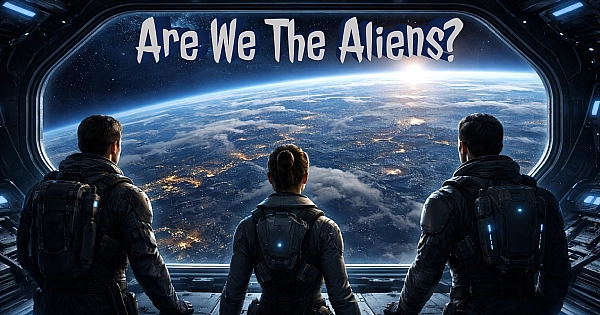
We've spent decades looking to the skies for signs of alien life, but what if we are proof that it does indeed exist? Humor me for a moment while I dive into a thought experiment that I'm sure will not pan out. But is fun to think about none the less.
We Are Kind Of Terrible At Living Here
We are the only species that gets burned by our sun if you go out unprotected. We can't drink water unless it is filtered without getting sick. We can't eat most of the food on this planet without first cooking it. We need clothes to survive the colder climates.
Our spines aren't even built for this planet. Humans are the only species that suffers from chronic back pain. It's almost as if our spines weren't built for the Earths gravity. Child birth is WAY harder for humans than it is for other species.
Humans look like they were dropped on this planet, mid-design, if compared to the local fauna.
It is easy to see how creationists can make the leap that a God created us, we seem so out of place here.
Evolutionists have answers for most of these questions as well. We get sunburned because when we left the trees, having no hair made it easier to cool the body down on the open savannah. Our spines are still evolving for standing upright and so on.
But, what if they are both right to some extent? What if we were created by another civilization and dropped here millennia ago and are still trying to adapt to the planet?
The Genetic Anomaly Problem
Humans share somewhere between 96 and 99 percent of their DNA with chimps depending on how you measure it, coding versus non-coding DNA, but either way the cognitive leap between us is almost absurd by evolutionary standards. Chimps have been using sticks as tools for tens of thousands of years, whereas humans went from steam power to space travel in under a century. That's insanely fast in the grand scheme of things.
We have transitional fossils that trace the human lineage back nearly 7 million years through Australopithecus, Homo habilis, and Homo erectus, but the direct common ancestor we share with chimps has never actually been found. The bridge between that common ancestor and our earliest known relatives is still missing. Could that gap be less of a missing link and more of a starting point?
More notable is our chromosome 2 fusion. Humans have 46 chromosomes while every other great ape has 48. The scientific consensus is that two ancestral chromosomes fused together at some point in our lineage, which does happen in nature, but what is harder to explain is how that mutation spread to every single human on Earth. A random chromosomal fusion in one individual doesn't just quietly become universal.
Even more interesting is the elegantly titled Mitochondrial Eve. All humans on Earth can be traced back through maternal lineage to a single woman living in East Africa somewhere between 150,000 and 200,000 years ago. She wasn't the only female alive at the time, but every other maternal lineage eventually died out. We are all her children.
Evidence From Ancient Times
In the Sumerian texts, which represent some of humanity's oldest written records, the Anunnaki are described as powerful beings who descended from the sky and created humans specifically to serve as a labor force. This isn't a loose interpretation either, it is a fairly direct reading of texts like the Atrahasis and the Enuma Elish.
Göbekli Tepe is a massive, sophisticated stone structure built around 12,000 years ago in what is now southeastern Turkey, and it predates the invention of agriculture by at least a thousand years. The people who built it were supposedly hunter-gatherers with no permanent settlements, no writing, and no organized society. Yet they quarried and moved limestone pillars weighing up to 20 tons and arranged them with deliberate astronomical precision. Who organized that?
The same question gets louder when you look at Sacsayhuamán in Peru, the massive fortress above Cusco built with stones so precisely cut and fitted together that a blade of grass won't pass between them. Even the Incans who inherited it acknowledged they didn't build it and attributed it to an earlier civilization. Modern engineers still aren't entirely sure how it was done.
Then there are the flood myths. Nearly every major ancient culture on Earth, Sumerian, Hebrew, Hindu, Greek, Mesoamerican, Chinese, has an independent story about a catastrophic flood that wiped out most of humanity and left a small group to start over. These cultures had no contact with each other. Is that a coincidence or a shared memory of something real? And if it was real, was the flood the end of wherever we came from, or the beginning of how we got here?
The Seeding Hypothesis
Here is where things get genuinely interesting and where science and speculation start to blur together in a fun way.
Panspermia is a legitimate scientific hypothesis that suggests life can travel between planets, hitching rides on asteroids and comets. It has real support in the scientific community. The directed version of that idea takes it one step further. What if life wasn't just drifting through space by accident, but was intentionally planted here by a civilization advanced enough to do it?
Mars is worth bringing up here. There is strong geological evidence that Mars was once a warm, wet, habitable planet billions of years before Earth was. If a civilization existed there, and their planet was dying, seeding a younger nearby world with life starts to sound less like science fiction and more like something we ourselves would probably try to do given the technology. We are already talking seriously about terraforming Mars right now.
So what if the story goes the other direction? What if we are the Martians?
Why We Act Like We Don't Belong
This is the part that gets me the most. Behavior is hard to fake and harder to explain away.
Humans are uniquely and almost obsessively drawn to the night sky. Every ancient civilization, completely independent of one another, built mythologies around the stars and described powerful beings descending from them. You could chalk that up to primitive people trying to explain the unknown, but the consistency across cultures that never had contact with each other is hard to brush off. It feels less like imagination and more like a shared memory of something.
More telling than our past is our future. We are the only species on this planet that is actively, desperately trying to leave it. Every other creature lives within its environment. We built rockets. We have government agencies and billionaires in a race to get off this rock and colonize another planet. No other animal has ever looked at its home and thought about how to escape it. Is that ambition or is it instinct pointing us somewhere familiar?
So Where Does That Leave Us?
None of this proves anything. The fossil gaps have mundane explanations. The ancient structures were built by incredibly resourceful people that we chronically underestimate. The chromosome fusion could be a cosmic coincidence. Mitochondrial Eve fits comfortably within standard evolutionary biology.
But the thought experiment is worth sitting with for a minute. Because if an alien civilization is out there and they eventually show up on our doorstep, there is a very real chance the most surprising part of that encounter will not be that they exist. It will be the moment one of them looks at us and says they already knew we were here.
Maybe we are not searching the stars for alien life. Maybe we are just trying to find our way home.