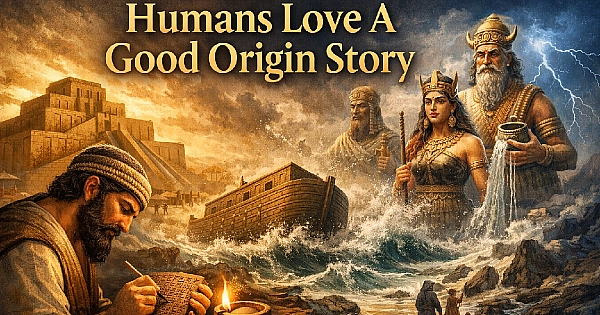
Humans Love A Good Origin Story
We've been telling stories of heroes, villains, gods, and kings for as long as we've had language. The real breakthrough came when humans developed a way to record those tales. While no one knows how far back storytelling itself goes, the earliest known writing we've found comes from the Sumerians around 3200 BCE.
The Sumerian civilization of Mesopotamia laid much of the groundwork for later complex societies. They developed cuneiform, a writing system impressed into clay tablets, built early cities, created complex government structures, and engineered sophisticated irrigation systems for farming. They're also credited with some of the earliest known wheels.
Mesopotamia, meaning "between rivers," was located in what is now modern-day Iraq, between the Tigris and Euphrates. The fertile river valleys made large-scale farming possible, allowing formerly nomadic hunter-gatherers to settle in one place, grow crops, and practice animal husbandry.
Civilization Allowed for Specialization
Being able to stay in one place and grow food was a game changer. Once communities had a surplus, people could specialize. Some built tools and weapons. Others farmed, herded animals, or worked as craftspeople. Toolmakers made better tools because that's all they did. Farmers produced more food because their tools improved. The feedback loop kept compounding.
One new role that emerged was the scribe. At first, they recorded trade, taxes, and inventories. Eventually, they began writing down stories that had been passed down orally for generations. Once myths were written, they could survive far beyond the memories of the people who first told them.
The most intriguing works these scribes left behind were stories about our origins. That's the question humans never stop asking: How did we get here, and what is our purpose? We may never fully know the answers, but you can't understand where a civilization is going without knowing where its stories began. So let's talk about some of the earliest Sumerian origin stories.
Creation Myths
All cultures tell origin stories, but Sumer gives us some of the oldest ones ever written down. In the Sumerian tradition, a primordial goddess named Nammu, associated with the cosmic waters, gives rise to the sky god An and the earth goddess Ki. From them comes Enlil, the god of air, who separates sky and earth and helps shape the ordered world. These myths don’t prove that Sumer invented every later legend, but they do show that some of humanity’s earliest written stories already contained ideas that would echo across civilizations for millennia.
The First Documented Flood Story
The oldest flood narrative we know of appears in a Sumerian text called the Eridu Genesis. In it, the gods grow tired of noisy humanity and decide to wipe them out with a great flood. The god Enki, however, secretly warns a pious king named Ziusudra to build a massive boat to save himself, his family, and living creatures. After surviving the deluge, Ziusudra offers sacrifices, and the gods relent. He is granted immortality and sent to live in Dilmun. This story predates later flood myths in Mesopotamia and the biblical tale of Noah, making it the earliest written version of a narrative that would be retold for thousands of years.
The Epic Of Gilgamesh
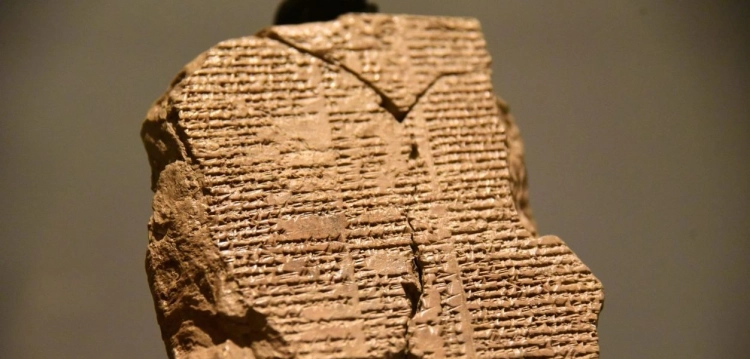
Written in Akkadian, the Epic of Gilgamesh built on the earlier Sumerian clay cuneiforms and tells a story that grapples with mortality, friendships, and a search for meaning. It shows how Sumerian story telling evolved from simple creation myths into complex narratives about the human condition. You can read the English translated version here.
The Goddess Who Dared to Die
If the flood story shows us how the Sumerians thought about divine judgment, the myth of Inanna's descent into the underworld reveals something even more unsettling: their gods weren't immortal in the way we might imagine. They could be stripped, humiliated, killed, and hung from a hook like meat in a butcher's shop. And the goddess who suffered this fate was Inanna, Queen of Heaven, goddess of love, sex, and war. She was powerful, proud, and apparently bored enough with her divine perfection to wonder what lay beneath the world of the living.
The story begins with Inanna hearing a call she can't ignore. Her older sister Ereshkigal rules the underworld, the realm of the dead, and for reasons the myth never fully explains, Inanna decides she needs to visit. Maybe it's curiosity. Maybe it's ambition. Maybe she just can't stand the idea of a kingdom she doesn't control. Whatever the reason, she knows it's dangerous. Before descending, she tells her servant Ninshubur: if I'm not back in three days, go to the gods and beg for help.
Then she goes down. At each of the seven gates leading into the underworld, the gatekeeper demands she remove a piece of her divine regalia; her crown, her jewelry, her royal robes. By the time Inanna reaches her sister's throne room, she's completely naked and powerless, stripped of everything that made her a goddess. Ereshkigal, bitter and grieving in her dark kingdom, judges Inanna for her arrogance, kills her, and hangs her corpse on a hook. The Queen of Heaven becomes a piece of rotting meat.
Back in the world above, Ninshubur follows her queen's instructions. She goes to the great gods for help, but most refuse to interfere with the underworld's laws. Only Enki, the god of wisdom and trickery, agrees to act. He creates two strange, sexless beings who slip into the underworld unnoticed. They find Ereshkigal in agony, not just emotional but physical, writhing in pain like a woman in difficult labor. The beings sympathize with her suffering, and touched by their compassion, she offers them a gift. They ask for Inanna's body. Ereshkigal agrees, and they revive the goddess with the food and water of life.
But there's a catch. The underworld has rules. No one leaves without sending someone else to take their place. When Inanna returns to the world of the living, she finds her husband Dumuzid sitting on her throne, dressed in fine clothes, throwing a party instead of mourning her death. Furious and betrayed, she fixes her eyes on him, the gaze of death, and condemns him to the underworld in her place. Dumuzid's sister Geshtinanna, heartbroken, offers to take his place for half the year. Inanna accepts. From that moment on, Dumuzid spends half the year in the land of the dead and half in the land of the living, and the world above cycles between abundance and barrenness, life and death, growth and decay.
This wasn't just an entertaining tale for the Sumerians. It was an explanation for why the world works the way it does. Why crops die and return. Why nothing lasts forever, not even the gods. And beneath that, it asked a question humans still wrestle with: what are you willing to sacrifice to gain power, and what happens when you lose everything that made you who you are? Inanna went into the underworld as a queen and came out transformed, stripped down to nothing and rebuilt. It's one of the oldest stories we have about what it means to die and come back changed.
Stories That Refuse to Die
The Sumerians gave us the templates for our modern day stories. The flood myth appears in the Epic of Gilgamesh, then in the Hebrew Bible, and eventually becomes Noah's Ark, a story millions still know by heart. The descent into the underworld? You can trace that thread through Greek myths of Persephone and Orpheus, through Dante's Inferno, all the way to modern stories about heroes journeying into darkness and emerging transformed.
What's remarkable isn't just that these stories survived, it's how they survived. Clay tablets preserved them in a way oral tradition never could. A story told around a fire changes with each telling, shaped by the memory and creativity of whoever's speaking. But once the Sumerian scribes pressed those wedge-shaped marks into wet clay, the stories became fixed points in time. They could be copied, studied, argued over, and reimagined by cultures that came centuries later. Writing didn't just record stories; it made them immortal.
We're still asking the same questions the Sumerians asked five thousand years ago: Where did we come from? Why do we suffer? What happens when we die? What makes someone worth remembering? The medium has changed from clay tablets to papyrus to printing presses to pixels on a screen, but the fundamental human need to tell stories and find meaning in them hasn't budged an inch.
The Sumerians were the original storytellers not because they were the first to speak, but because they were among the first to write it all down and make sure we'd never forget. And we haven't.