
Monday, Tuesday, Wednesday...
You say them constantly. Monday, Tuesday, Wednesday. They roll off your tongue so automatically that you probably never stop to ask where the words actually came from. But every one of them is a little fossil, a leftover from ancient sky-watchers, dead gods, and a calendar that has been quietly running for thousands of years.
The short version is this: the seven-day week comes to us from the ancient world, and the days are named after the seven things our ancestors could see moving across the sky.
Seven wandering lights
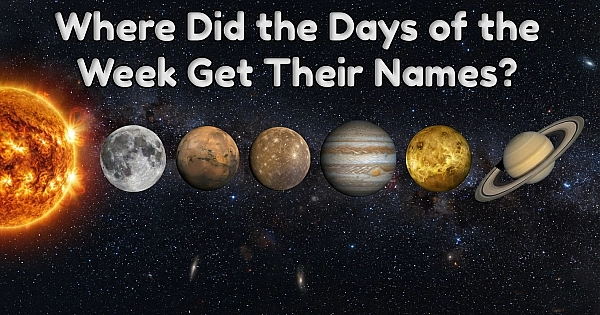
Before telescopes, anyone looking up at night could pick out seven objects that drifted against the fixed background of stars: the Sun, the Moon, and the five planets visible to the naked eye, which are Mercury, Venus, Mars, Jupiter, and Saturn. The Greeks called them the planetes, the wanderers. Babylonian astronomers had already tied these seven bodies to a repeating seven-day cycle, and the Romans inherited the whole idea, naming each day after one of the seven and the god attached to it.
So in Latin you ended up with:
- dies Solis the Sun's day (Sunday)
- dies Lunae the Moon's day (Monday)
- dies Martis Mars' day (Tuesday)
- dies Mercurii Mercury's day (Wednesday)
- dies Iovis Jupiter's day (Thursday)
- dies Veneris Venus' day (Friday)
- dies Saturni Saturn's day (Saturday)
If you know any French, Spanish, or Italian, those probably look familiar. French lundi, mardi, mercredi, jeudi, vendredi are Moon, Mars, Mercury, Jupiter, and Venus, barely disguised.
So why don't the English days sound like that?
Here is where it gets fun. English is not a Romance language, it is a Germanic one. When Germanic-speaking peoples picked up the Roman week, they did not simply borrow the Roman gods. They swapped in their own, matching each Roman deity to the closest equivalent from their own mythology. Scholars call this interpretatio germanica, which is a fancy way of saying "the local translation."
The Sun and the Moon crossed over easily enough. Sunday is Old English Sunnandaeg, the Sun's day, and Monday is Monandaeg, the Moon's day.
Then the old gods start showing up:
- Tuesday is Tiw's day. Tiw, also called Tyr, was a Germanic god of war and law. The Romans had named this day for Mars, their war god, so Tiw was the natural stand-in.
- Wednesday is Woden's day. Woden, better known by his Norse name Odin, got matched to Mercury. It seems like an odd pairing at first, but both were tied to travel, eloquence, and guiding the dead, so the resemblance made sense to them.
- Thursday is Thunor's day. Thunor is Thor, the thunder god, and he lined up neatly with Jupiter, the Roman king of the sky and thrower of thunderbolts.
- Friday is Frigg's day. Frigg, a goddess of love and marriage, was the obvious match for Venus.
The odd one out
Saturday is the lone holdout. While the rest of the week got a Germanic makeover, Saturday kept its Roman owner: Saeternesdaeg, Saturn's day. Nobody seems to have had a good local equivalent for old Saturn, so the Roman name just stuck. It is the one day in the English week still wearing its Roman name out in the open.
There is a neat parallel hiding here. The Romance languages did the opposite trick at the other end of the week. Their Sunday and Saturday got Christianized, so French dimanche comes from "the Lord's day" and samedi traces back to "Sabbath," while the middle of the week kept the pagan planet-gods. English kept the Sun and Saturn but paganized the middle. Same Roman starting point, two completely different routes.
So which day is the first day of the week?
This one genuinely depends on where you live. In the United States, Canada, Japan, and much of Latin America, the calendar starts on Sunday, so the week runs Sunday through Saturday. Flip a wall calendar in those countries and Sunday sits in the leftmost column. Much of the rest of the world, including most of Europe, treats Monday as day one, and that is also what the international standard ISO 8601 specifies. In a number of Middle Eastern and North African countries the week has traditionally begun on Saturday or Sunday instead, with Friday as the main day of rest.
So who is right? Everybody, sort of. The Sunday-first habit is the older one, rooted in the Jewish and early Christian counting where Saturday was the seventh-day Sabbath and Sunday the first day. The Monday-first convention is the newer, work-week-driven view: once Saturday and Sunday became "the weekend," it felt natural to bundle them together at the end and let the work week lead. Same seven days, just two different ideas about where the starting line sits.
Why are they in that strange order?
Here is the part that rewards a little nerdiness. The order of the planets in the week does not match their order in the sky, and that is because of something called planetary hours. Ancient astrologers assigned every hour of the day to one of the seven planets, cycling through them from slowest-moving to fastest: Saturn, Jupiter, Mars, Sun, Venus, Mercury, Moon. The planet that ruled the first hour of a day gave that day its name.
Run that across a full 24-hour day and the first-hour planet skips three spots every morning, which spits out exactly the weekday order we still use: Saturn, Sun, Moon, Mars, Mercury, Jupiter, Venus. The week you live by is basically a fossilized astrology spreadsheet.
So the next time Monday rolls around and you groan about it, you can at least appreciate that you are complaining about the Moon. The whole week is a quiet little museum of ancient astronomy and forgotten gods, hiding in plain sight on your calendar.