Why We Have So Many Counties
Once upon a time, America was big, empty, muddy, and extremely inconvenient.
Picture a farmer in 1790. He wakes up before dawn, feeds the animals, kisses his kids goodbye, and then realizes he has a problem. He needs to file a deed, settle a dispute, or pay a tax. The nearest government office is three days away by horse, assuming the horse doesn’t die, the river isn’t flooded, and no one steals his boots.
This is the real reason counties exist. Not politics. Not bureaucracy. Not a secret plot by cartographers. Pure, stubborn logistics.
Government on Horseback
In the early days, America didn’t have email, phones, or even decent roads. Government had to be close enough that a normal person could reach it, do their business, and get home before starvation or bandits became a serious concern.
So states drew lines.
Then they drew more lines.
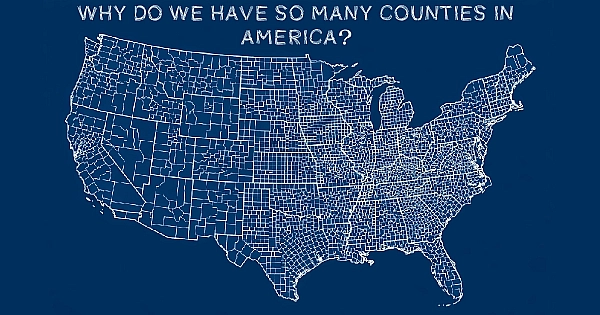
Whenever a courthouse got “too far away,” the solution wasn’t better transportation. It was to split the county in half and build another courthouse. Repeat this process for about 250 years and you get what we have now: over 3,000 counties, parishes, and county-equivalents scattered across the map like someone dropped a box of crackers.
The Magic Number: One Day’s Ride
Many early counties were designed so you could ride from the edge of the county to the courthouse and back in a single day. That distance varied wildly depending on terrain.
Flat land? Huge counties.
Mountains? Tiny counties.
Swamps? Counties shaped like someone sneezed while drawing them.
This is why western states like Nevada have monster counties, while eastern states look like a shattered mirror. Virginia alone has more counties than some entire regions of the world.
Local Power, Local Control
There’s another reason counties multiplied: Americans don’t trust distant authority. Never have.
Counties became the level of government where things felt human. Sheriffs you might actually know. Judges who lived nearby. Tax assessors who understood that your barn collapsing wasn’t a creative accounting trick.
When communities grew, they wanted their own officials, their own budgets, and their own say. The fastest way to do that was to carve out a new county and slap a name on it; often borrowed from a Revolutionary War hero, a European noble, or whichever politician had the biggest ego that year.
States Played Favorites
Some states went absolutely feral with county creation.
Georgia once had over 160 counties, partly because politicians wanted courthouses close enough to influence voters and jobs close enough to reward friends. Texas went big but sparse. Louisiana did its own thing entirely and called them parishes, because Catholicism never misses a chance to be extra.
Alaska looked at the whole idea and said, “No thanks,” opting for boroughs and vast stretches of organized shrugging.
The Modern Weirdness
Today, counties handle elections, jails, courts, roads, property records, public health, and a thousand other unglamorous tasks that keep society from falling apart.
Do we still need this many? Probably not.
Will we ever get rid of them? Also probably not.
Counties are baked into state constitutions, funding formulas, legal systems, and local identities. Removing them would require coordination, trust, and restraint; three things Americans famously lack.
A Map Full of History
Every county line is a fossil. It marks where people lived, how they traveled, what they feared, and how far they could reasonably go without the whole day falling apart.
So the next time you zoom in on a map and wonder why the United States looks like it was divided by an indecisive pizza cutter, remember this:
America didn’t plan for the future.
It planned for a guy on a horse who really needed to get home by dinner.