
The Rock That Will Brush Our Sky: Apophis and the 2029 Close Call
On a Friday the 13th, in the spring of 2029, millions of people will be able to look up at the night sky and see something unforgettable. A massive asteroid named Apophis will sweep past Earth, close enough to rattle satellites, close enough to make you wonder how thin the line really is between everyday life and cosmic chaos.
Apophis is no ordinary space rock. At more than a thousand feet across, it is large enough to erase a city in a single strike. And for a brief moment in 2004, when it was first discovered, scientists believed it might actually be on a collision course with Earth. That brush with potential doom gave Apophis a reputation that has stuck ever since.
The Discovery That Worried Astronomers
Apophis was discovered in June 2004 by astronomers at the Kitt Peak National Observatory in Arizona. At first it was just another dot among the thousands of near-Earth objects tracked each year. But when researchers plugged its position into their orbital models, the numbers came back with a startling possibility: there was a significant chance this asteroid could strike Earth on April 13, 2029.
For months, Apophis dominated both headlines and hushed conversations in the astronomy community. It was given a rating of “4” on the Torino Impact Hazard Scale, the highest ever recorded at the time, which meant the risk of a global disaster was not only real but worthy of international attention. In simple terms, it was the first asteroid humanity had ever found with a truly frightening chance of impact.
As more observations came in, astronomers refined the orbit and the doomsday headlines cooled. By 2006, improved radar data had ruled out a 2029 collision. Still, the scare was enough to brand Apophis forever as “the asteroid that almost hit us.”
Apophis and Its Chaotic Path
Apophis doesn’t wander through the solar system randomly. Like all asteroids, it follows an orbit governed by the Sun’s gravity. What makes Apophis special is how that orbit intersects with our own.
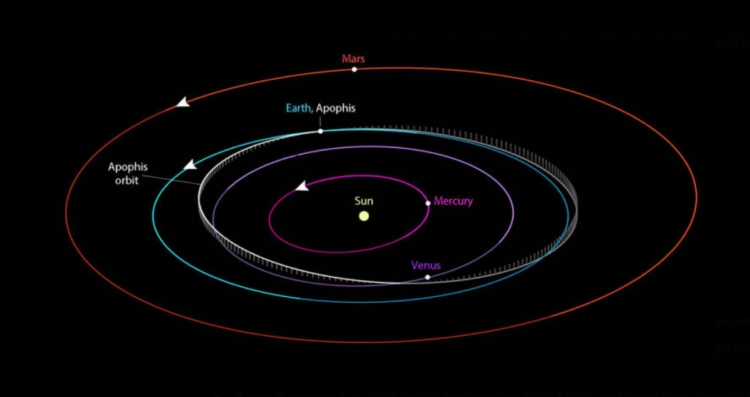
The asteroid takes about 323 days to circle the Sun. At its closest, it dips inside Earth’s orbital path, just three-quarters of the way to the Sun. At its farthest, it travels slightly beyond our orbit. This back-and-forth makes Apophis a near-Earth asteroid, one of many that cross our cosmic neighborhood.
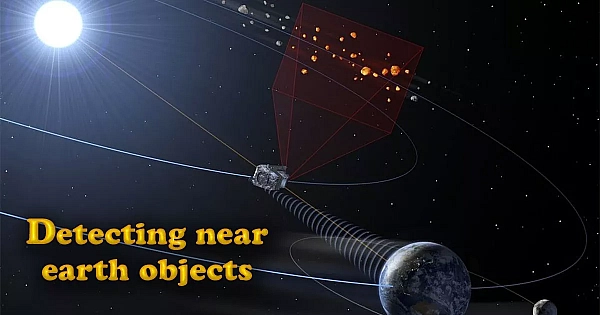
Its orbit is tilted only a few degrees from Earth’s plane, which means it frequently passes near us. Each encounter with Earth’s gravity tweaks the orbit slightly, nudging it one way or another like a ball rolling across a pool table. Over decades, these nudges add uncertainty to its exact future path, which is why astronomers track it so carefully.
A Night to Remember: April 13, 2029
The date is already circled on the calendars of sky watchers around the world. On Friday, April 13, 2029, Apophis will make its closest approach to Earth. The asteroid will pass only 32,000 kilometers or 20,000 miles above the surface, closer than many communications satellites.
This won’t be a hidden event for specialists. For the first time in modern human history, people across large parts of the world will be able to step outside and watch a giant asteroid drift across the stars with the naked eye. From Europe, Africa, and Asia, Apophis will appear as a bright moving point, shining as brightly as the stars of the Big Dipper. It will be slow enough that you can track its movement against the background constellations in real time.
To put that in perspective: meteors and shooting stars zip across the sky in an instant, but Apophis will be a steady traveler, almost like watching a new planet rise and move. For many, it will be the closest brush with deep-space danger they will ever see.
What Would Happen if Apophis Hit Earth?
Let’s address the question everyone asks. No, Apophis will not hit Earth in 2029. The orbit is well known, and the path has been calculated with high precision. But what if it did?
An object more than a thousand feet across carries unimaginable energy. If Apophis were to strike land, it could obliterate an area the size of a large city, creating shockwaves, fires, and debris that would darken the skies. If it landed in the ocean, towering tsunamis could spread across coastlines. Scientists estimate the energy of impact would be equivalent to tens of thousands of nuclear bombs.
This would not wipe out humanity like the dinosaur-killer asteroid 65 million years ago, which was ten times larger. But it would be a disaster on a scale that would change history forever. Cities would fall, economies would collapse, and every culture on Earth would have a new myth about the day fire came from the sky.
Ancient Echoes of Cosmic Fear
Humans have always feared the heavens. To ancient cultures, comets and meteors were omens of war, plague, or divine wrath. Chinese records describe “guest stars” blazing in the sky. The Babylonians and Egyptians tracked celestial events and tied them to the fate of kings.
Naming Apophis after the Egyptian god of chaos was no accident. In mythology, Apophis was the serpent who tried to devour the Sun every night. Priests would chant spells to keep him at bay. Now, thousands of years later, modern astronomers chant with mathematics and radar dishes instead of prayers. But the fear is the same: a cosmic intruder that threatens the order of the world.
The Close Call That Changed the Game
Even though Apophis won’t hit Earth, its discovery sparked serious conversations about planetary defense. For the first time, governments and space agencies had to consider what humanity could do if an asteroid really were on a collision course.
NASA, ESA, and other agencies began funding missions to test ways of deflecting or disrupting asteroids. The most recent success was the DART mission in 2022, which slammed a spacecraft into a small asteroid moonlet and shifted its orbit. That test proved that with enough warning, humans can change the path of a threatening asteroid.
In a sense, Apophis has already done us a service. By scaring us in 2004, it pushed the world to take asteroid defense seriously. When the next real threat comes, and someday it will, we’ll be more ready than ever before.
After 2029: What’s Next for Apophis?
The story doesn’t end with the dramatic flyby. Passing so close to Earth will actually change Apophis’ orbit. Earth’s gravity will tug on it, shifting its path into a new trajectory. Astronomers expect the orbit to shorten slightly, altering how often it crosses our path.
There are known encounters in the decades after 2029, including in 2036, but none present a danger of impact. For at least a century, Apophis will be more of a celebrity than a threat. But its new orbit will be studied carefully, because each gravitational nudge changes the math a little. The serpent of chaos may be chained, but no chain lasts forever.
A Night of Wonder, Not Doom
When April 13, 2029, arrives, the world won’t be ending. Instead, it will be a night of wonder. A chance to look up and remember that we live in a solar system full of moving stones and silent giants. Most pass unnoticed. A few come close enough to raise our blood pressure.
For once, we’ll get to see one glide past harmlessly, a cosmic reminder that our place in the universe is fragile. For the children who watch it with their parents, Apophis may be the spark that inspires the next generation of astronomers, engineers, and explorers.
And for all of us, it will be proof that apocalypse can sometimes be postponed. The serpent in the sky will not devour us this time.